






Low storage buffers, higher gas prices: What shaped the energy markets in September
Summary
September brought significantly more movement to the energy markets. Spot power prices increased by 21% month-on-month, while the 2027 annual contract rose by 9.3%. The main drivers were higher gas prices, fluctuating wind and solar generation and temporary reductions in French nuclear availability.
Pressure also increased in the gas market. Restricted LNG flows through the Strait of Hormuz, low European storage levels and maintenance in Norway kept prices high. Towards the end of the month, diplomatic signals and increasing LNG shipments provided some relief.
Oil and coal prices also increased in September. CO₂ prices moved higher as well, but played a much smaller role in overall energy price developments than gas, supply risks and geopolitical uncertainty.

Fluctuating wind and solar generation pushes spot prices higher
In September, the average day-ahead price was €152.21/MWh, around 21% higher than in August. Prices fluctuated significantly during the month. One of the main factors was the amount of wind and solar power available. When renewable generation was high, prices fell. In the evening, however, solar output declined. When this happened at the same time as low wind generation, more conventional power plants were needed to meet demand.
September showed several examples of how strongly this can affect prices. In week 37, the power price briefly rose to around €605/MWh. In the following week, prices reached around €617/MWh on Monday evening. Once wind generation increased again, prices quickly eased.
High gas prices push forward power prices higher
Forward power prices also increased in September. The 2027 power contract rose by 9.3% to €126.54/MWh. Higher gas prices were the main driver. Restricted shipping through the Strait of Hormuz increased the risks to LNG supplies from the Gulf region and kept European gas prices high. This also increased expected generation costs for gas-fired power plants.
However, power prices did not follow gas prices one-for-one. At the start of the month, stable French nuclear generation and the availability of cheaper generation sources helped limit the increase. Later in the month, lower river levels and reduced French nuclear availability added further pressure before several reactors returned to the grid.
Flamanville 3 also remains relevant for the 2027 contract. The planned inspection of the French nuclear plant will continue into next year and therefore affects expectations for French nuclear availability in 2027.

Geopolitical risks push gas prices significantly higher
Gas prices increased significantly in September, although they eased somewhat towards the end of the month. The TTF Cal 27 contract closed at €56.75/MWh, up 11.4% compared with the end of August. The Front-Month contract increased by 3.7% to €72.36/MWh.
The main reason was the continued tension around the Strait of Hormuz. Restricted shipping increased the risks to LNG supplies from Qatar and the United Arab Emirates. At the same time, Europe had to compete more strongly with Asia for alternative LNG cargoes, while shipping and insurance costs also increased.
The market was already facing a tight supply situation ahead of winter. European gas storage levels were below normal seasonal levels, while maintenance in Norway temporarily reduced pipeline supplies. Geopolitical risks therefore hit a market with a relatively limited supply buffer. 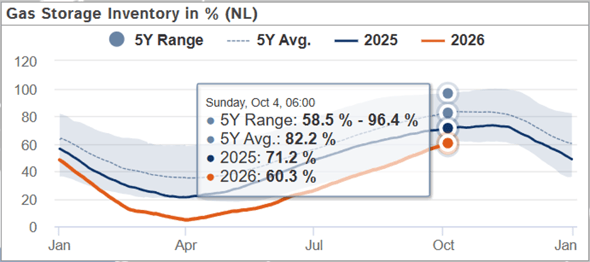
Further disruptions added pressure during the month. Following drone attacks, Saudi Arabia’s East-West pipeline was temporarily closed. The direct impact was mainly on the oil market, but higher oil prices can also make oil-linked LNG contracts more expensive and therefore indirectly affect European gas prices.
Diplomatic signals provide some relief
Towards the end of September, the market eased somewhat. More positive diplomatic signals between the US and Iran, together with signs of increasing shipping activity in the Gulf region, reduced some of the risk premium.
LNG shipments from Qatar also started to increase again. Several loaded tankers left the Gulf region after shipments had been heavily restricted in August. However, the market was still far from normal, as contracted deliveries had not yet fully recovered.
Despite this improvement, the supply situation remained tight. Europe entered the winter period with relatively low storage levels, leaving the market vulnerable to new supply disruptions or an early cold spell.

Oil
Oil prices increased significantly in September and moved above $100 per barrel at times. The main drivers were geopolitical tensions in the Middle East and the resulting risks to global oil supply.
Restricted shipping through the Strait of Hormuz was a major source of uncertainty. Further pressure came from the temporary closure of Saudi Arabia’s East-West pipeline following drone attacks. As this pipeline is an important alternative route to the Strait of Hormuz, fewer secure export routes were available for oil from the Gulf region. Attacks on Russian refineries and lower Russian fuel exports added further concerns about available supply.
Prices also fell sharply at several points during the month. Hopes of talks between the US and Iran temporarily reduced concerns about further supply disruptions. The partial restart of Saudi Arabia’s East-West pipeline also provided some relief.
Towards the end of the month, prices moved higher again. Limited progress in talks between the US and Iran and continued strong demand kept uncertainty high. Overall, the oil market remained strongly influenced by geopolitical risks and possible disruptions to global supply.
Coal
Coal prices increased overall in September and briefly reached their highest level in six months. Tight supply was one of the main reasons. In particular, fewer short-term cargoes were available from Colombia, further tightening supply to the European market.
High gas prices also supported demand for coal. When gas becomes more expensive, coal can become more competitive for power generation. This is particularly relevant during periods of low wind and solar generation, when more conventional generation is needed.
Coal prices fell temporarily during the month, but overall price levels remained elevated. High CO₂ prices limited some of the increase. Coal-fired power plants emit more CO₂ than gas-fired plants and therefore need more emission allowances. This increases their generation costs and reduces some of the cost advantage compared with gas.
Coal therefore remained an important factor for power prices in September, particularly when less electricity was available from wind, solar, hydropower or nuclear generation.
CO₂
The CO₂ price increased by 2.39% to €85.09/tCO₂ in September. The market followed the wider upward movement in energy prices but was not a major driver itself.
Prices received some support from expectations of higher fossil-fuel power generation. When more gas- or coal-fired power plants are used, demand for emission allowances also increases. High gas prices can make coal more competitive for power generation, which can further increase demand for CO₂ allowances.
At the same time, industrial demand remained relatively weak and financial investors were also cautious. This limited stronger price increases. Political developments also created some uncertainty. A possible tightening of the Market Stability Reserve could reduce the supply of allowances and support prices. Additional free allowances for industry, on the other hand, could reduce market demand.
Outlook
Gas and power prices increased again at the start of October after falling towards the end of September. The market therefore remains volatile, with several factors influencing the direction of prices.
Stable LNG supplies to Europe, mild weather and higher French nuclear output could provide relief. This would reduce gas demand for heating and power generation while increasing the availability of lower-cost electricity.
In contrast, renewed disruptions to shipping or an early cold spell could quickly push prices higher again. European gas storage levels are entering winter with a relatively limited buffer, meaning additional demand or supply disruptions could have a stronger impact.
For the 2027 annual contracts, two factors remain particularly important: reliable LNG supply to Europe and French nuclear availability. Short-term changes in the weather forecast are less important for these longer-term contracts.